[Under Review] Impact of Temporally-Varying Geographic Predictors on Long-Term Air Pollution Exposure Estimation for Epidemiology
Abstract
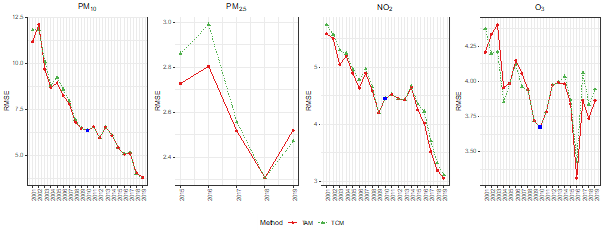
Many cohort studies have investigated the health effect of long-term exposure to air pollution using exposure prediction models, given the lack of individual-level measurements. In these models, the characterization of individual exposures at the fine spatial scale was based on hundreds of geographic variables that represent potential pollution sources such as traffic and land use. However, most studies constructed these variables from a fixed time, failing to account for temporal changes, which may lead to exposure misclassification and biased or imprecise health effect estimates. This study aimed to improve the predictive performance of models for four criteria air pollutants (PM10, PM2.5, NO2, and O3) using time-aligned geographic characteristics for 2001–2019 in South Korea. From hourly measurements of particulate matter ≤ 10 or 2.5 μm per diameter (PM10), nitrogen dioxide (NO2), and ozone for 2001-2019 and PM2.5 for 2015-2019 at 136-422 regulatory air quality monitoring sites in South Korea, we computed annual-average concentrations at each site. We also computed over 300 geographic variables related to traffic, land use, vegetation, elevation, emissions, and population in 2001, 2005, 2010, 2015, and 2019 to match to the closest year of air pollution. Spatial prediction models were then constructed within a universal kriging framework, incorporating predictors selected from 322 geographic variables using partial least squares regression and spatial correlation analysis. Here, we applied two sets of variables- time-aligned geographic variables, and time-constant variables calculated from the one year in 2010. Model performance was compared between the two approaches. Cross-validation R2 values for PM and NO2 were generally similar to or higher with time-aligned covariates compared to time-constant geographic variables. The improvement for O3 was higher in recent years than in early years. Our findings suggest the significantly role of temporal changes of geographic characteristics in estimating long-term exposure to air pollution of individuals for cohort studies.